
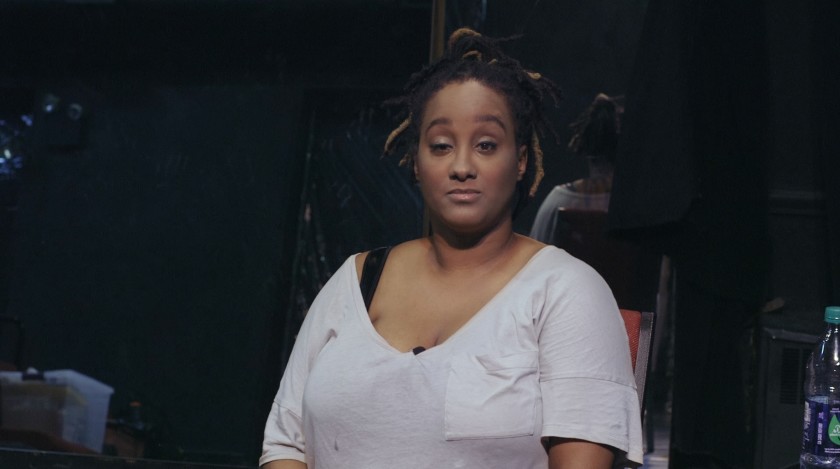
The Reelout Festival film Vision Portraits is a documentary style film about the lives of four people from different genders, sexual orientations, ethnicities, etc. with one thing in common – they are all visual impaired. The film is split into four story lines following the lives these people and the various obstacles they face every day. Intersectionality is a very prominent concept throughout this film because blindness is not the only form of oppression these individuals face. The representation of race, gender, and ableism is strong throughout the film as there are many different ways in which intersectionality affects the characters. In a society where the representation of disability in the media is severely lacking, Vision Portraits does a good job in allowing the audience to empathize with the characters as they explain what it was like to lose something we often take for granted such as vison, and how they have adapted and risen above their disability despite their struggles. The characters are able to share how issues such as ableism and intersectionality have affected their lives, as well as how they chose to overcome to obstacles associated with ableism and intersectional oppression.
The film begins with the introduction of Rodney Evans, a focal point in the film as well as the director and producer. Evans is a director who is almost completely blind, and is also coloured, in his early years he worked as an actor before his vision made it too difficult to work. Sharing his experience of losing the ability to do something he loved such as acting allowed the audience to better understand how often people with disabilities have to give up things that used to be normal in their lives, as well as the sacrifices they are forced to make. This representation of sacrifice reflects the oppression of intersectionality as well as ableism that Evans experienced in his life. Evans recalled a time that he had an altercation with a few individuals on a train, they had been yelling at him for not moving quick enough to get off the train. Although from their position behind him, he seemed to be able-bodied, he suffered verbal abuse for his disability. Telling this story in the documentary represented how even something as simple as getting off the train becomes difficult and how many people in society do not take the time or the patience to analyze a situation before resorting to verbal or even physical abuse. Adding personal stories also created a picture in the audiences’ mind about what being visually impaired might actually feel like, thus creating more empathy between the character and the audience.

Intersectionality is a highly prominent concept throughout the entire film. Two of the other main characters in the film display many layers of intersectionality, although both take their oppression in stride. One character is John Dugdale, a gay, disabled man who happens to be HIV positive and had a career as a photographer before losing his sight. Once finding out that he was never going to see again, everyone told him he could not take pictures anymore. Dugdale rose above this discrimination and continued to take pictures by using his description skills to allow his crew to set up the scenery exactly how he imagined. The other character who possessed an even deeper level of intersectionality was Kayla Hamilton, visually impaired, black female. Hamilton frequently addresses how the various levels of oppression have affected her everyday life and how like Dugdale, she chooses to rise above it. In today’s society and throughout history, being black – and more specifically – being female and black has been a struggle for so many who have fought for equality. For Hamilton, adding blindness into the mix only further emphasizes the daily obstacles she must face. In “Escaping the ‘Evil Avenger’ and the ‘Supercrip’: Images of Disability in Popular Television, the author states that gender studies have found fictional characters in the media to be stereotyped into not developing into full-rounded characters, and that disabled people in the media often also experience that fate (21, 2000) this further emphasizes how the media and society view women and people with disabilities. Hamilton had to deal with both of these issues as well as being a person of colour, which made her story that much more powerful and impacting to the audience.
The film’s representation of disability is also very prominent in the way it displays the extra work that people who are visually impaired have to do in order to succeed. For example, the character Ryan Knighton was a writer before he became blind, and as his vision began to go that didn’t stop him from reading and writing. While reading one of his short stories at a coffee shop, he is told to keep restarting until he gets it right, in order to show everyone how much harder he is working to present his story. Showing the strength of these people despite their disabilities opposes the ideas society has about disabled people by showing the audience that disability does not trap an individual, they just have to work even harder to achieve their goals. As previously mentioned, the character John Dugdale was a photographer before becoming blind, and after he had gone legally blind his family thought he could no longer be a photographer. Society has convinced us that disabled people cannot do things that able-bodied people can, like in “Being in Question” the author says that “early-onset disability can be understood as some version of wrongness… because it violates the anticipated continuity of sameness as non-disabled status within families” (124, 2017). Dugdale’s family believed his disability meant he could not continue with a career such as photography now that he was disabled, however he proved them wrong and defied the norm in society that disabled people are lesser than that of able-bodies.

In conclusion, the film Vision Portraits did a very good job representing the disabled community as well as defying cultural and societal norms about what disabled people can and cannot do. It also allowed the audience to connect and empathize with the characters while they shared their stories and how they chose to rise above their obstacles. Finally, the film’s characters each had their own issues with intersectionality and the variety of stories that came from the different levels of oppression also allowed the audience to better understand how living with discrimination and oppression from the public and private eye effects their everyday lives, whether that be positive or negative.
Word Count: 1086
References
Ahmed, S. (2017) Being in Question https://read-dukeupress-edu.proxy.queensu.ca/books/book/1933/chapter/191590/Being-in-Question [Accessed February 13, 2020]
Harnett, A. (2000). Escaping the ‘Evil Avenger’ and the ‘Supercrip’: Images of Disability in Popular Television. https://arrow.tudublin.ie/cgi/viewcontent.cgi?article=1077&context=icr https://arrow.tudublin.ie/cgi/viewcontent.cgi?article=1077&context=icr [Accessed February 13, 2020]




 Vision Portraits Blog